
For the most part, I like living in Loonfoot Falls. The air is clean, the people are friendly, and mosquitoes aren't a problem after the first few killing frosts.
I suppose this exposes my rural naïveté, but it hadn't occurred to me until this week that Loonfoot Falls lacks one vital facet of contemporary culture.
We have not one single gated community.
Unless you count places like Fisk Implement. They've had a sturdy fence and a mildly paranoid alarm system ever since someone stole a harrow, back in 1996. Nobody lives there, apart from the occasional gopher: so it's not really a "community."
We don't have all that many fences of any sort in town. Much less walled-off neighborhoods where everybody inside is glad that they're not outside. I'm not sure if that says more for our values: or our desire to avoid having to mow near a fence.
It's not like we're some homogenized classless utopia. Houses around West 9th and Waterview Lane, or around Milldam Park, tend to be bigger than the ones on Siding Street. More expensive, anyway.
Some of the Waterview Lane places put on a nice show around Christmas time. The rest of the year, though, their yards are pretty plain. Nicely mowed, of course. Very trim.
Some of the folks who live on Siding Street don't wait for some holiday to embellish their lawns. Artificial deer are fairly popular. So is that sort of wind sculpture that looks like a duck flapping its wings.
Showing posts with label community. Show all posts
Showing posts with label community. Show all posts
Friday, November 5, 2010


Friday, February 19, 2010
'When Does it Warm Up Around Here?'
Central Minnesota isn't for everyone. It's the weather, I think. Dr. Glenn DeLoach, at Foggton State University, told me about a new faculty member he'd been sent to meet at the airport. It was one of those beautiful late-fall days: cloudless sky; and temperature around 60. Fahrenheit, that is. It was so warm, Dr. DeLoach left his jacket in the car.
The first words the newcomer said to Dr. Deloach were, "when does it warm up around here?!"
He lasted, I'm told, about three months.
Life in a small town isn't for everyone, either. Particularly for folks who think of Foggton, home to around 50,000 people, as a "small town." I'll grant that it's not like Los Angeles, which can be a good thing or a bad one: depending on what you're looking at.
Then there are places with a bar, two or three churches, a grain elevator and a hundred people or so. Now that's a small town!
One thing I've heard about small towns is that they're cliquish. I suppose it's true: but then we're supposed to be too interested in each other's lives, too. I grew up here, so I'm used to living in a place where I know my neighbors, and am related one way or another to a good-sized fraction of the town.
Like I said, it's not like Los Angeles.
It's not like those "small town museums" you see, either. Those generally show the way small towns were like: maybe a hundred years ago.
The first words the newcomer said to Dr. Deloach were, "when does it warm up around here?!"
He lasted, I'm told, about three months.
Life in a small town isn't for everyone, either. Particularly for folks who think of Foggton, home to around 50,000 people, as a "small town." I'll grant that it's not like Los Angeles, which can be a good thing or a bad one: depending on what you're looking at.
Then there are places with a bar, two or three churches, a grain elevator and a hundred people or so. Now that's a small town!
One thing I've heard about small towns is that they're cliquish. I suppose it's true: but then we're supposed to be too interested in each other's lives, too. I grew up here, so I'm used to living in a place where I know my neighbors, and am related one way or another to a good-sized fraction of the town.
Like I said, it's not like Los Angeles.
It's not like those "small town museums" you see, either. Those generally show the way small towns were like: maybe a hundred years ago.
Friday, July 10, 2009
Loonfoot Falls Community Theater: Recycling Keeps Them in the Green
I caught Flora Ellert, Loonfoot Falls Community Theater's Dramatics Director, in a talkative mood this week. LFCT has been working on this summer's show: something called "Magic: A Fantastic Comedy."
That play wasn't what we talked about, though. I'd mentioned that the LFCT hadn't done a musical since "Doctor Jekyll, Please Don't Hyde!" in 2004.
Flora Ellert didn't say what that musical's royalties were, but I learned that stage musicals can cost between $250 and $500 for each performance - just for the right to use a script and music. Comedies and dramas, she told me, run around $65 for opening night and $35 a show after that. Then there's the matter of paying for each copy of the script, or a fee for the right to make photocopies.
"Sure: It's fun; it's art. It's business, too, sort of," she explained. Loonfoot Falls Community Theater is a non-profit outfit, with everybody volunteering their time. But, she pointed out, besides the royalties there's rental for the rehearsal and performance space, and generally some expense for sets, props, and costumes.
"We save quite a bit on our sets. Einar Johnson's something of a genius when it comes to re-using materials each year," Flora explained. Einar created Dr. Jekyll's laboratory out of pieces of sets for a Victorian sitting room, an apartment's kitchen, and PVC pipe that's been ship's rigging, trees in Sherwood Forest, a telescope and lamp posts.
Frances Robinson applies the same recycling principles to the theater's costumes. But that's another topic.
That play wasn't what we talked about, though. I'd mentioned that the LFCT hadn't done a musical since "Doctor Jekyll, Please Don't Hyde!" in 2004.
Flora Ellert didn't say what that musical's royalties were, but I learned that stage musicals can cost between $250 and $500 for each performance - just for the right to use a script and music. Comedies and dramas, she told me, run around $65 for opening night and $35 a show after that. Then there's the matter of paying for each copy of the script, or a fee for the right to make photocopies.
"Sure: It's fun; it's art. It's business, too, sort of," she explained. Loonfoot Falls Community Theater is a non-profit outfit, with everybody volunteering their time. But, she pointed out, besides the royalties there's rental for the rehearsal and performance space, and generally some expense for sets, props, and costumes.
"We save quite a bit on our sets. Einar Johnson's something of a genius when it comes to re-using materials each year," Flora explained. Einar created Dr. Jekyll's laboratory out of pieces of sets for a Victorian sitting room, an apartment's kitchen, and PVC pipe that's been ship's rigging, trees in Sherwood Forest, a telescope and lamp posts.
Frances Robinson applies the same recycling principles to the theater's costumes. But that's another topic.
Friday, February 27, 2009
What are Friends For?
Minnesota got quite a lot of snow yesterday. That sparkling new ground cover is beautiful: as long as you're a winter sports enthusiast, or don't have to go outside.
Snow loses some of its luster, if you you've got a job, and need to shovel out your garage door, so you can get at the snowblower, so you can cut a path to the street.
A friend of mine was up before sunrise, shoveling out his garage door. He'd tried opening it from the inside: but snow melting and re-freezing had glued the door in place. It didn't take more than about fifteen minutes to free up the door, and then it was just a matter of blowing out snow faster than the wind blew it in.
He'd cut a path from the garage to the street, through the ridge the plows left, he was good to go. The drive to work was quiet. Times being what they are, he hadn't gotten the car radio fixed. Who needs a radio, anyway, right?
The place he works is about a mile out of town, and the roads were closing in, but he made it. The parking lot was empty. And, the windows were really dark.
The shop closing had been announced on radio, and they'd tried calling him: while he was outside.
He called me this morning. He'd made it back into town, and into his driveway, before the car got stuck. It's still there: he needed a ride to work.
Snow loses some of its luster, if you you've got a job, and need to shovel out your garage door, so you can get at the snowblower, so you can cut a path to the street.
A friend of mine was up before sunrise, shoveling out his garage door. He'd tried opening it from the inside: but snow melting and re-freezing had glued the door in place. It didn't take more than about fifteen minutes to free up the door, and then it was just a matter of blowing out snow faster than the wind blew it in.
He'd cut a path from the garage to the street, through the ridge the plows left, he was good to go. The drive to work was quiet. Times being what they are, he hadn't gotten the car radio fixed. Who needs a radio, anyway, right?
The place he works is about a mile out of town, and the roads were closing in, but he made it. The parking lot was empty. And, the windows were really dark.
The shop closing had been announced on radio, and they'd tried calling him: while he was outside.
He called me this morning. He'd made it back into town, and into his driveway, before the car got stuck. It's still there: he needed a ride to work.
Saturday, August 23, 2008
Loonfoot Falls' Backyard Butterfly Preserves
There's very little grass in some Loonfoot Falls back yards. Colorful splatters of wildflowers and milkweed have replaced the neatly-trimmed lawns of over a dozen houses.
And that's just the way the owners want it.
They're members of the Asclepias Society, an organization dedicated to giving monarch butterflies a place to stay and raise a family at the summer end of their migration. The Asclepias Society was founded in 2000 by Samuel H. Robins, chief entomologist at the Minnesota Institute for Scientific Studies.
That was the year when the monarch butterfly became Minnesota's state butterfly.
The Asclepias Society gets its name from the scientific name for milkweed, a plant that young monarchs munch before turning into the orange-and-black adults.
A member of the Loonfoot Falls chapter, Howard Leland, said, "I thought it sounded crazy at first. You know: making your back yard into a butterfly preserve?" He decided to try planting wild flowers and milkweed in his back yard in 2005. After four summers with the Asclepias Society, the only part of his back yard not covered with flowers and milkweed is a path to the garage.
"It's great," Mr. Leland said. "Those wildflowers pretty much take care of themselves, and watching the butterflies beats most of what's on television."
This year's monarchs are either already on their way south, or soon will be. Mr. Leland and his fellow-Asclepiasans want to make sure that when another generation returns next year, they'll find plenty of butterfly-friendly back yards in Loonfoot Falls.
And that's just the way the owners want it.
They're members of the Asclepias Society, an organization dedicated to giving monarch butterflies a place to stay and raise a family at the summer end of their migration. The Asclepias Society was founded in 2000 by Samuel H. Robins, chief entomologist at the Minnesota Institute for Scientific Studies.
That was the year when the monarch butterfly became Minnesota's state butterfly.
The Asclepias Society gets its name from the scientific name for milkweed, a plant that young monarchs munch before turning into the orange-and-black adults.
A member of the Loonfoot Falls chapter, Howard Leland, said, "I thought it sounded crazy at first. You know: making your back yard into a butterfly preserve?" He decided to try planting wild flowers and milkweed in his back yard in 2005. After four summers with the Asclepias Society, the only part of his back yard not covered with flowers and milkweed is a path to the garage.
"It's great," Mr. Leland said. "Those wildflowers pretty much take care of themselves, and watching the butterflies beats most of what's on television."
This year's monarchs are either already on their way south, or soon will be. Mr. Leland and his fellow-Asclepiasans want to make sure that when another generation returns next year, they'll find plenty of butterfly-friendly back yards in Loonfoot Falls.
Thursday, August 21, 2008
Protecting the Squirrely Way of Life in Loonfoot Falls
Once, squirrels in Loonfoot Falls were able to run from Mosquito Flats to the fairgrounds, from the Belvedere-Union-Grand Hotel to Oak Grove Park, without setting foot on the ground, or in a tree.
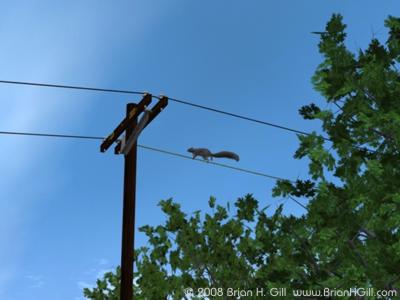
Those days are gone.
Like so many towns, Loonfoot Falls has been burying its utilities. Overhead telephone and power lines have, over the years, been replaced by underground cables. Loonfoot Falls' Utilities Department has pointed out the advantages: greater reliability and safety.
Safety for the human population, perhaps: but not for the squirrels. These furry citizens are now forced, in many neighborhoods, to cross streets by leaping from one tree's outermost branches to another, or risk life and pelt in a mad dash across the pavement.
Concerned citizens have banded together to form the Society for the Preservation of Overhead Squirrel Highways. Members of SPOSH are gathering petitions, in an effort to prevent Loonfoot Falls' remaining power and telephone poles, and the lines connecting them, from going the way of the steam railroad.
Anastasia Anderson, founder and president of SPOSH, hopes to have enough signatures to put a 'save the poles' referendum on the local election ballots, later this year.
"We aren't against underground cables: We just want to make sure that our squirrely neighbors have a safe way to cross the street," Anderson explained. "Under the SPOSH proposal, as overhead lines are replaced with underground cable, squirrel-friendly lines will be strung between poles, providing safe transit over the streets, and preserving a tradition of inter-species cooperation."
Those days are gone.
Like so many towns, Loonfoot Falls has been burying its utilities. Overhead telephone and power lines have, over the years, been replaced by underground cables. Loonfoot Falls' Utilities Department has pointed out the advantages: greater reliability and safety.
Safety for the human population, perhaps: but not for the squirrels. These furry citizens are now forced, in many neighborhoods, to cross streets by leaping from one tree's outermost branches to another, or risk life and pelt in a mad dash across the pavement.
Concerned citizens have banded together to form the Society for the Preservation of Overhead Squirrel Highways. Members of SPOSH are gathering petitions, in an effort to prevent Loonfoot Falls' remaining power and telephone poles, and the lines connecting them, from going the way of the steam railroad.
Anastasia Anderson, founder and president of SPOSH, hopes to have enough signatures to put a 'save the poles' referendum on the local election ballots, later this year.
"We aren't against underground cables: We just want to make sure that our squirrely neighbors have a safe way to cross the street," Anderson explained. "Under the SPOSH proposal, as overhead lines are replaced with underground cable, squirrel-friendly lines will be strung between poles, providing safe transit over the streets, and preserving a tradition of inter-species cooperation."
Monday, July 21, 2008
"Robin Hood: Ninja of Sherwood"
The Loonfoot Falls Community Theater's production last week of "Robin Hood: Ninja of Sherwood" wasn't the usual Sherwood Forest story. Instead of Lincoln Green, Robin Hood's merry men were garbed in what we're told is Sherwood black.
The curtain opened with Sir Guy of Gisbourne proposes marriage to Maid Marian, clearly to get control of her considerable wealth. When she refuses, he inexplicably grabs a ball from a table and runs from the room.
Maid Marian ends the scene with, "You have dishonored my family! You will pay!"
We meet Robin Hood in the second act. He's a shepherd who went with one of Marian's knight's to a Crusade. The knight also brought back Tuk, a refugee of some sort, who's getting as far west as he can.
Maid Marian recruits Robin Hood and Tuk to harass Sir Guy. They prove to be quite good at it. Tuk has been teaching Robin Hood some very un-English things to do with his quarterstaff and feet.
When Robin Hood isn't redistributing Sir Guy's wealth, he and Maid Marian are driving Sir Guy to distraction with the idea that she prefers a shepherd's attentions to his.
A spectacular moment in the play was unrehearsed. Robin Hood's quarterstaff got away from him in the third act. It flew straight and true toward Maid Marian, played by Sonja Branstetter, whose Soo Bahk Do training let her catch it with a flourish.
"Robin Hood: Ninja of Sherwood" won't be forgotten by Loonfoot Falls any time soon.
The curtain opened with Sir Guy of Gisbourne proposes marriage to Maid Marian, clearly to get control of her considerable wealth. When she refuses, he inexplicably grabs a ball from a table and runs from the room.
Maid Marian ends the scene with, "You have dishonored my family! You will pay!"
We meet Robin Hood in the second act. He's a shepherd who went with one of Marian's knight's to a Crusade. The knight also brought back Tuk, a refugee of some sort, who's getting as far west as he can.
Maid Marian recruits Robin Hood and Tuk to harass Sir Guy. They prove to be quite good at it. Tuk has been teaching Robin Hood some very un-English things to do with his quarterstaff and feet.
When Robin Hood isn't redistributing Sir Guy's wealth, he and Maid Marian are driving Sir Guy to distraction with the idea that she prefers a shepherd's attentions to his.
A spectacular moment in the play was unrehearsed. Robin Hood's quarterstaff got away from him in the third act. It flew straight and true toward Maid Marian, played by Sonja Branstetter, whose Soo Bahk Do training let her catch it with a flourish.
"Robin Hood: Ninja of Sherwood" won't be forgotten by Loonfoot Falls any time soon.
Friday, July 11, 2008
Loonfoot Falls Community Theater Prepares Unique Robin Hood
Turnabout is fair play: at least, it is at Loonfoot Falls Community Theater. Last year's production, "Little Women," didn't have many roles for men in the community.
Finding a suitable play to even the score wasn't as easy as you might think. Van Epps' adaptation of "Moby Dick" was suggested, and considered, until the LFCT board noted that this "Moby Dick" was a musical, set in an academy for young ladies.
"Mutiny on the Bounty" was rejected because there weren't enough funny lines in any of the available stage adaptations. "I think we could have re-written some of the scenes as comedy relief," said Flora Ellert, LFCT Dramatics Director.
They finally settled on an adaptation of "Robin Hood" that had quite a few male roles, with a range of ages from pre-teens to men in their fifties.
"It'll be a lot of fun: comedy, drama, cunning, and derring-do," said Ellert. "It's sort of like the Errol Flynn 'Robin Hood,' except the guys won't be wearing tights."
Possibly the most unusual aspect of the Loonfoot Falls "Robin Hood" will be that this Outlaw of Sherwood Forest won't use a bow and arrow. "That was understood from the start. We don't want a repeat of that William Tell thing," Ellert said, recalling a near-miss on stage, back in 1997.
"So, we decided that our Robin Hood had been in the Crusades," Ellert continued, "where he met a fugitive from Japan, and became a ninja. I don't think anyone's thought of that before."
Finding a suitable play to even the score wasn't as easy as you might think. Van Epps' adaptation of "Moby Dick" was suggested, and considered, until the LFCT board noted that this "Moby Dick" was a musical, set in an academy for young ladies.
"Mutiny on the Bounty" was rejected because there weren't enough funny lines in any of the available stage adaptations. "I think we could have re-written some of the scenes as comedy relief," said Flora Ellert, LFCT Dramatics Director.
They finally settled on an adaptation of "Robin Hood" that had quite a few male roles, with a range of ages from pre-teens to men in their fifties.
"It'll be a lot of fun: comedy, drama, cunning, and derring-do," said Ellert. "It's sort of like the Errol Flynn 'Robin Hood,' except the guys won't be wearing tights."
Possibly the most unusual aspect of the Loonfoot Falls "Robin Hood" will be that this Outlaw of Sherwood Forest won't use a bow and arrow. "That was understood from the start. We don't want a repeat of that William Tell thing," Ellert said, recalling a near-miss on stage, back in 1997.
"So, we decided that our Robin Hood had been in the Crusades," Ellert continued, "where he met a fugitive from Japan, and became a ninja. I don't think anyone's thought of that before."
Subscribe to:
Posts (Atom)


